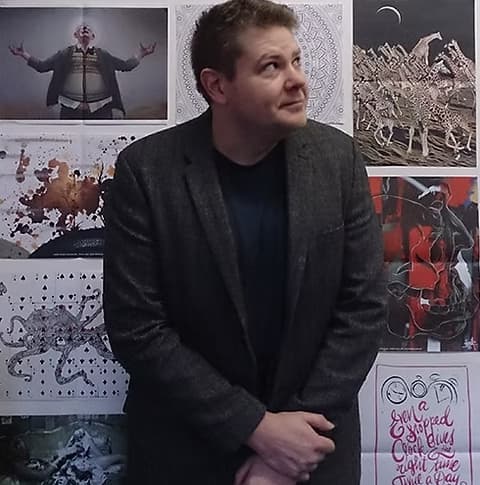
A Generative Interview with James Lock from Opus Independents
James Lock is co-founder and director of Opus Independents.
This interview was conducted by Peter Pula from the Generative Journalism Alliance. It forms part of a collaborative inquiry with the Many-To-Many (M2M) Learning Network as it comes to a close in June 2026, and begins to seed possibilities for what comes next.
When it comes to the Many-To-Many network how do you characterize that work and journey? What has it been about for you?
I entered the network with a very place-based challenge in mind. That work is less about delivering a specific project and more about developing the civic capability required to act collectively on complex transitions. We are trying to create the governance, relationships, legitimacy and resource flows that allow multiple actors to coordinate around shared purposes and generate many different projects, interventions, and investments over time.
I got this kind offer from Annette to join this M2M governance network and suddenly realized this is something that other people are trying to puzzle out as well.
What is meant by M2M beyond the conventional thinking about governance? What are the differences that make the difference?
Most governance is a form of contracting. That's often the frame.
Most contracting is one-to-one: The landlord to the tenant.
Or, one-to-many: Philanthropy to a load of grantees.
Very rarely do you get M2M where there is an equity built into the relational ecosystem of the contracting.
When you're dealing with problems where no single actor can hold the problem space. One-to-many won't work because you're always driving risk and responsibility either downward into the many and they can't hold it. Or you're requiring a single point to be the arbiter of a complex problem that requires multiple actors to have agency in it to resolve it and respond well.
How, then, does M2M governance work?
A key difference for me is the wide and the narrow boundary missions.
In the global north we're really good at narrow-boundary goal setting and achieving. But in doing that really well, we tend to externalize all the things that sit outside of the goal.
We could think of wide-boundary goals as creating the conditions for a form of entangled wisdom for recognizing spillover effects or unintended consequences. That might help us make better decisions about our narrow boundary goals or how narrow our narrow boundary goals should be.
The Dark Matter Labs (DML) team and others were already thinking about this. We'll have in these contracts a wide boundary mission and a narrow boundary mission. We can use the wide boundary mission as a checking capability, a way of asking if we have strayed from the path? Has our narrow boundary goal had some spillover effects we don't want because they ruin our wide boundary goal?
That was absolutely fascinating and a really good way of contracting our missions, which, in our space, tend to be quite ambitious. They tend to be multi-sector, grounded in a lot of different kinds of theory and a plurality of needs. Having the combination of those missions, those goals, helps divvy up some of that stuff so you can get down to what you specifically want to be intentional about in a particular form of contracting.
Before Many-To-Many, I hadn't really appreciated the value of things like trigger events in contracting. When the context changes, trigger events can play a role in nurturing and formalizing adaptations in governance.
What triggers an overall change in the governance, or what triggers a moment where a group of people review whether something is still true or not? It could be that the amount of capital involved is changing, or the number of people involved, or the mission is changing. All of these trigger whole governance reviews.
In our contracting, how can we take a multi-capital view on value and risk? How can we value more things than just financial contributions?
Something I first encountered in this network is the eight permaculture forms of capital. That is quite a helpful list when you're trying to surface risk between people and groups.
How many capitals are there here? If multiple, how many?
We trialed this in the River Don project.
It was really interesting to consider the eight permaculture capitals and ask what the risk is related to a particular kind of capital. If your capital is that you're very well-networked, a trusted community organization but quite small scale, then the risk to your capital is a potential loss of trust in the constituency you serve. That trust is often mission critical in work on complex problems.
Surfacing that up into the risk registers was really cool.
There was also learning about different types of IP and the use of that IP. Has the IP been sourced through a collaboration or an organization? How do we bring it into the governance? If I've developed some sort of amazing thing on my own and choose to bring it into this project, then I get to keep it. But if it matures from the project itself it's effectively owned by the collaboration.
The deep code shifts really struck me.
A nut we never cracked was the role of more-than-human, and future generations stewards. We recognized there needed to be a stewardship function within the governance that held this lens of how our actions are affecting future generations. We didn't get to crack that one.
Wow. So far you've mentioned trigger events, multiple capitals view on value and risk, narrow and wide boundary goals, IP, and more-than-human, and future stewarding.
Yeah. Towards the end of last year I came to the realization that M2M was better described as a suite of possible technologies. In all the ways we might mean that. Social technologies as well as others.
The Many-To-Manying in many ways was the choices you make about combining them or not.
You might not need all of them. You're picking and choosing from this toolbox and what works for a particular context.
DML and Annette and others have laid out this philosophical grounding around deep codes that helps you orient your choices.
It was so meticulously well done.
What would you like to experience next in this?
The current cohort have done a good stint. It's got to a useful stopping point in the sense that there's an output that's got some clarity to it. There's the Field Guide as well as examples of the contract we ran together in the cohort.
I would like more people to use it and to develop it. That's, in part, why we're doing the event and why we've shared the field guide. They provide stepping off points for people to try some of it out and to evolve their own practice.
What we probably need is loads of resource channeled into complex, domain, problem, or place-specific groups who have got a real need for this type of governance. We need them to be getting on with it and be supported to do so. Then we need the learning to come back into the whole and to be turned into something that can be adapted and embodied, where useful, by others.
I'm very keen to apply this in Sheffield in the work that we're doing.
We have large public sector institutions, large civil society organizations like universities or colleges. We also have small community organizations, small and large private sector organizations to consider, as well as all the different domains they're all in.
Some are working in health, some in education, some on particular products, some working with particular communities, or in particular places.
What I'd like to happen is that we show the value of thinking about M2M governance and for that to mature into the contracting of place-based missions.
How could you bring that about?
It's possible in the Sheffield City Goals work, which is a big piece of work for us.
In our civic infrastructures it is widely accepted that no single actor can solve these complex problems.
Nobody is saying, "I've totally got this."
That is a pretty critical foundation for something like M2M. If you realize you can't solve the problems on your own then we're going to need to do it with others.
That's going to be recursive. We will need to work out how we can work well with lots of people who have different skills and gifts and so on.
The challenge is getting people to see beyond organizational remits, you know, 'I don't need to worry about that problem that no single actor can solve because I am a single actor, and I've been told what my problem remit is. As long as I operate well within my problem remit, knowing, for example, that I can't solve poverty, I can't solve climate change. But my remit knows that, so I've just gotta respond within my remit and I'll be okay.'
If we can get past that bit, which needs for people to not run away or withdraw, or do any of those classic human reactions when something's too big or too difficult, then we can have a conversation about systemic risk and about systemic risk over time.
We can have a conversation about value, value at risk, and about efficiencies and how that all works.
We can have a conversation about the risk of doing nothing.
Then we probably get to a good place where we can start saying, "We are all bringing different things to the table. All those things are really useful. It is interesting to think about all those things in different combinations."
Then we might get to contracting. If we think all those things are useful and more useful in their combinatory effects than they are on their own, then how can we contract in a way that preserves them and the contribution they make in their combinations?"
Now we might be getting somewhere.
What's the best thing that could happen?
That more people, organizations, and groups feel that it might be possible to address systemic problems. To think about how M2M governance and collaboration could work differently and at different scales. I could imagine that leading to different types and different combinations of Many-To-Many all over the world, learning being shared, refinements and improvements being made.
I'd like for us to begin thinking about interesting ideas like federalizing versions of Many-To-Manys. Maybe we begin to say, "Remember the 2020s, when people did mergers? How ridiculous that was?"
Now we just do Many-To-Manys.
That feels like a generative image of the future, Mr. Lock.
My hunch is that in the future M2M system you would see a greater crystallization of that new type of organizational form. Cross-sector. Cross-domain. Relational work will enable really interesting innovations guided by a different set of organizing principles and value contributions.
I could imagine M2M transforming what we think an organization is, and therefore transforming how we think about the relationship between state and market.
Wow. Is there an invitation that you could make now, James?
The invitation is always to think about how the thing that you care about most is actually the combination of many other things. The invitation is to ask yourself: How much do you want to stretch from the thing that you care about in your core in order to hold the wider systemic overspill?
For those who feel like they want to stretch, M2M is really exciting. If you're interested in entangled problems you might find this stuff helpful.
Beautiful. Thank you, James.